
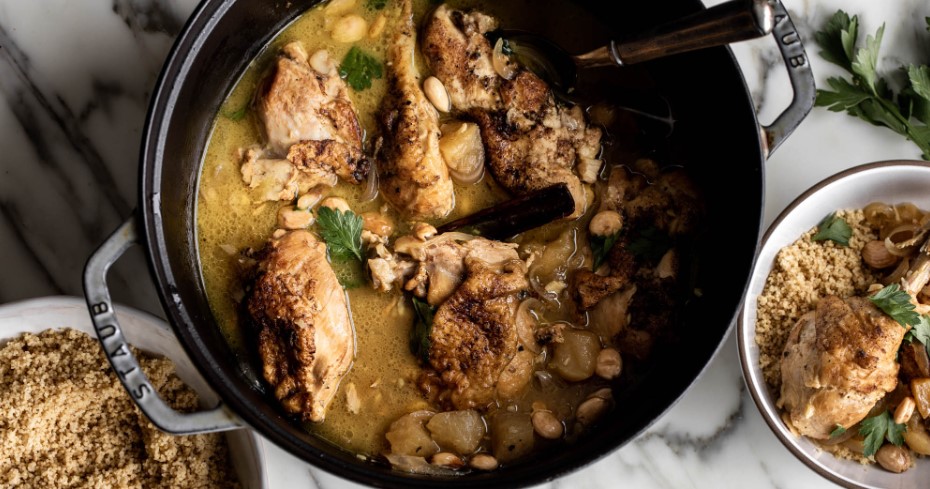
Cherifa, a friend of mine who is of Algerian origin, owns La Casbah, an Algerian restaurant in a town near mine called Acquigny. The chefs at La Casbah are Algerian women, clad in traditional garb, who make
only the most traditional of Algerian dishes from Cherifa’s recipes, including this tagine. What makes this tagine better than most is the balance of almonds and spices, as well as the apples, which are included because they are the fruit of Normandy, Cherifa’s adopted home.
Tagine refers to a two-piece clay oven with a peaked lid that is pierced with a tiny hole, as well as to the stew cooked inside. The ingredients are first browned in the bottom part of the oven, which islike a large, shallow dish, over the coals. Then the top is set in place, and the mixture braises and mellows. Tagines were traditionally made
with what was easily available, and in the Maghreb, as northern Africa is called, that means almonds and sesame seeds, abundant dried fruits, and poultry. Chicken is typical, but here guinea fowl is used to dress up the dish, take it uptown. However, if guinea fowl is hard to get, buy a good farm-raised chicken or a leg or shoulder of lamb.
Try a lovely Beaujolais, such as one from Moulin Blanc.
Makes 4 servings
Ingredients:
3 tablespoons vegetable oil, such as canola One 3-pound (1.5-kg) guinea hen or chicken, cut into 6 serving pieces
Fine sea salt and freshly ground white pepper
4 onions, diced
Two 4-inch (10-cm) cinnamon sticks ½ teaspoon saffron threads
1 teaspoon ground ginger
1 thick coin fresh ginger, peeled and minced (about 1 teaspoon)
1 bunch of cilantro, tied together with kitchen string
3 tablespoons (45 g) unsalted butter ¼ cup (60 ml) honey
5 good-size apples, peeled, cored, and thinly sliced
½ cup (70 g) raw almonds
3 tablespoons orange flower water
2 tablespoons sesame seeds, lightly toasted
Note: Don’t forget the sesame seeds atop the dish; they add not only their toasty flavor but a healthy touch of iron too.
Directions:
1. Heat the oil in the bottom of a tagine or in a heavy skillet over medium heat. Add the guinea hen, season lightly with salt and pepper, and cook until the pieces are golden on each side, a total of about 8 minutes. Remove the guinea hen and add the onions to the pan. Cook, stirring frequently, until the onions are golden, about 8 minutes. Add 1 cup (250 ml) water to the pan and stir, then add the cinnamon sticks, the saffron, 1 teaspoon salt, ½ teaspoon pepper, the ground and fresh ginger, and the cilantro and stir to thoroughly combine. Nestle the guinea hen pieces down among the onions and bring the water to a boil. Reduce the heat so the water is simmering, and cook the guinea hen, turning it at least three times so that it is impregnated with the spices, until it is tender, about 30 minutes.
2. While the guinea hen is cooking, melt the butter in a saucepan over medium heat. Add the honey, apples, and almonds and cook, stirring often, until the apples are just tender and beginning to caramelize on all sides and the nuts are golden, about 10 minutes. Watch the apples carefully to be sure they don’t burn, and reduce the heat if necessary.
3. When the apples are cooked, fold them into the pan with the guinea hen, along with the almonds and their cooking juices. Stir in the orange flower water. Cover and cook just until all the flavors meld and the apples begin to melt, about 10 minutes. Remove from the heat.
4. Remove the cinnamon sticks and the bouquet of cilantro. Adjust the seasoning, sprinkle the sesame seeds over all, and serve immediately.
Argan Oil
I first tasted argan oil at Arpège, Alain Passard’s nearly vegetarian three-star restaurant in Paris, about ten years ago. The oil had been much in the news at that time, vaunted as the latest culinary wonder, imported directly from Morocco. Dark golden and slightly gamy tasting, it didn’t make me swoon, but I have become and remain a
devotee because of the people behind its production, the women of the Sousse plain in southwestern Morocco.
Fruit from the argan tree (Argania spinosa) has long been harvested by Berbers living on the Sousse plain, the only place the twisted, thorny tree thrives. Traditionally, goats were the handmaidens of its production, for they scramble up the trees and perch on its limbs to eat the soft fleshy fruit, expelling the pit that contains the cherished nut. Today, however, while goats still do the work on remote farms, argan fruit destined for commercial
production is harvested from the tree by human workers.
The production of argan oil, which has traditionally been used in Morocco as both a condiment and a cosmetic, has always been women’s work, and thus it remains. Women collect the fruit and let it dry in the sun. Once dry, the nut is separated from the fruit and cracked open using a small oval stone. Inside is the oil-rich kernel. These are roasted, then ground.
Thanks to Zoubida Charrouf, a professor in the science department at Mohammed V University in Rabat, Morocco, who has made the production of argan oil a personal mission because she realized that it sustained an important rural population, and to the government of King Mohammed VI, argan oil cooperatives have been established. With the multiple goals of creating sustainable argan forests and improving women’s rights, these cooperatives allow women to work in good conditions, get decent pay, and have time to take care of their children. Other countries like Monaco contribute funds to the argan project, and UNESCO has weighed in by designating the 10,000-mile argan region as a biosphere, acknowledging the conservation and sustainable development of the argan oil industry.
If, like me, you don’t love the taste of argan oil, you may like the way its considerable vitamin E and essential fatty acids soften your skin and can give it what the French call éclat, or “luminosity.” If its nutty flavor appeals to you, then do as the Berbers do and drizzle it on raw vegetables or couscous before steaming or mix it with honey
and almonds to make amlou, a tahinilike paste. Whatever its use, argan oil sustains on every level.
