
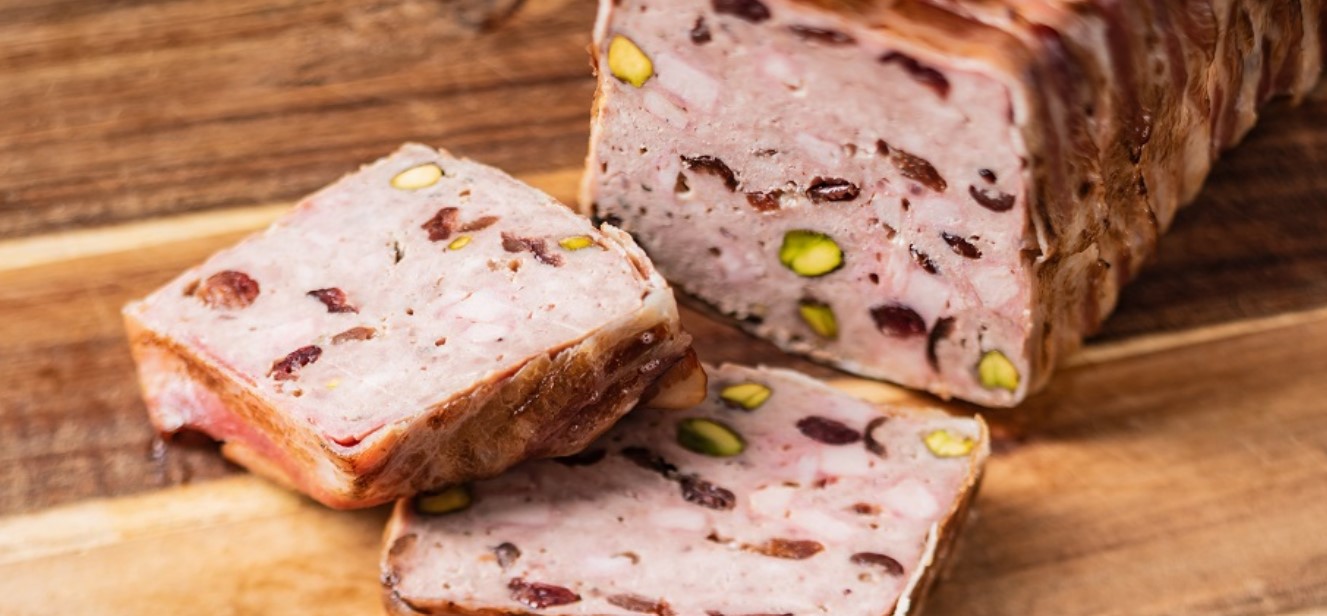
Fit for Company, Fit for a Crowd, Keeps Well
Franco Dunn, the founding chef of the former Santi Restaurant in Santa Rosa, in California’s Sonoma County wine-growing region, is known for his authentic rustic Italian fare. Franco is justifiably proud of his Italian salumi, especially this peasantstyle terrine, which is an Italian cousin to the rustic French pâté de campagne. This one was inspired by a similar dish he ate in Umbria, where it was made with wild boar instead of pork, which is a great substitution.
Serves 10 to 12
INGREDIENTS:
- 1 tablespoon bacon fat or olive oil
- 1 cup chopped onions
- 1 10-ounce bag cleaned spinach
- 1 pound boneless Boston butt (pork shoulder butt), cut into 1-inch cubes
- ½ pound pork fatback (see Cook’s Notes, [>]), cut into ½-inch cubes
- 1 pound pork liver or chicken or duck livers, cut into ½-inch cubes
- ¼ pound pork skin, boiled and cut into 1-inch cubes, or 2 packets (4½ teaspoons) unflavored gelatin, dissolved in ¼ cup warm water (see Cook’s Notes)
- 2 tablespoons salt
- 2 teaspoons freshly ground black pepper
- 1½ teaspoons fennel pollen (see Sources) or ground fennel seeds
- ¼ teaspoon ground allspice
- ¼ teaspoon freshly grated nutmeg
- 2 garlic cloves, minced
- 2 tablespoons grappa or brandy
- 2 teaspoons finely grated lemon zest
- 2 teaspoons chopped fresh thyme
- 2 teaspoons sugar
- 1 large egg, lightly beaten
- 2 fresh thyme sprigs
INSTRUCTIONS:
- Heat the fat in a medium skillet over medium heat. Add the onions, cover, and cook, stirring occasionally, until quite soft, about 10 minutes. Transfer the onions to a bowl and refrigerate for at least 30 minutes.
- Bring a large pot of water to a boil. Cook the spinach until just wilted, about 1 minute, then drain in a colander. Rinse under cold running water and squeeze dry. Chop roughly and cool in the refrigerator for at least 30 minutes. (The onions and spinach can be covered and refrigerated overnight.) Using a meat grinder fitted with a ⅜-inch plate, grind the pork into a large bowl (if you have one, use the bowl for a standing electric mixer, because you’ll be using a mixer to combine the pâté ingredients) or coarsely chop in a food
processor into about ⅜-inch pieces (see Cook’s Notes). Change to an ⅛-inch plate. In another bowl, stir together the fatback, ½ pound of the liver, the pork skin or gelatin, and cooked onions and spinach and grind the mixture into the bowl with the pork butt or chop in the food processor into about ⅛-inch pieces. Add the remaining diced liver and all the remaining ingredients except the thyme sprigs and mix on medium speed with an electric stand or hand mixer until well combined, 2 to 3 minutes. Or, beat well by hand with a sturdy wooden spoon. - Preheat the oven to 300°F, with a rack in the middle of the oven.
- Put on some water to boil. Meanwhile, lay the thyme sprigs in the bottom of a 9- ×-5-inch (7-cup) loaf pan or terrine. Scrape the meat mixture into the pan. Cover tightly with aluminum foil and put the pan in a roasting pan or baking dish. Place in the oven and add enough boiling water to the roasting pan to come two thirds
of the way up the sides of the loaf pan. Bake for 1¾ to 2 hours, or until the internal temperature registers 155°F to 160°F on an instant-read thermometer. Remove from the oven and let cool for 2 hours, then cover with plastic wrap and refrigerate overnight. (The terrine can be refrigerated for up to 1 week.) - To serve, unmold the terrine onto a cutting board. Remove the thyme sprigs and discard. Cut the terrine into ½-inch-thick slices. Allow to warm at room temperature for 10 to 15 minutes before serving.
COOK’S NOTES:
- Pork liver can be rather strong and is not to everyone’s taste (although some of the strong taste will be removed if you soak the pork liver. If you prefer a milder taste, use chicken or duck livers, or a mixture.
- Boiled pork skin provides the gelatin that makes the slices firm so that they don’t fall apart. You can get pork skin from farmers’ markets or special-order it from your butcher. It also contributes an earthy taste. To prepare the skin, simmer in water to cover for at least 2 hours, or until very soft. Drain. (The skin can be stored in a covered container in the refrigerator for up to 4 days or in the freezer for up to 3 months.) You can also use the rind trimmed from slab bacon. If you’re using gelatin, dissolve it by sprinkling it over ½ cup warm water in a small bowl. Let sit for about 5 minutes.
- If you chop the ingredients in a food processor, it’s better to err on the side of too coarse than to turn the meat into a puree. Sometimes I weight my pâtés and terrines so that they have a firmer texture. To do this, cut a piece of cardboard to just fit on top of the pâté inside the pan. Wrap the cardboard in aluminum foil and set a few heavy cans on top or find a brick that will fit inside the mold (wrap it in aluminum foil first).
