
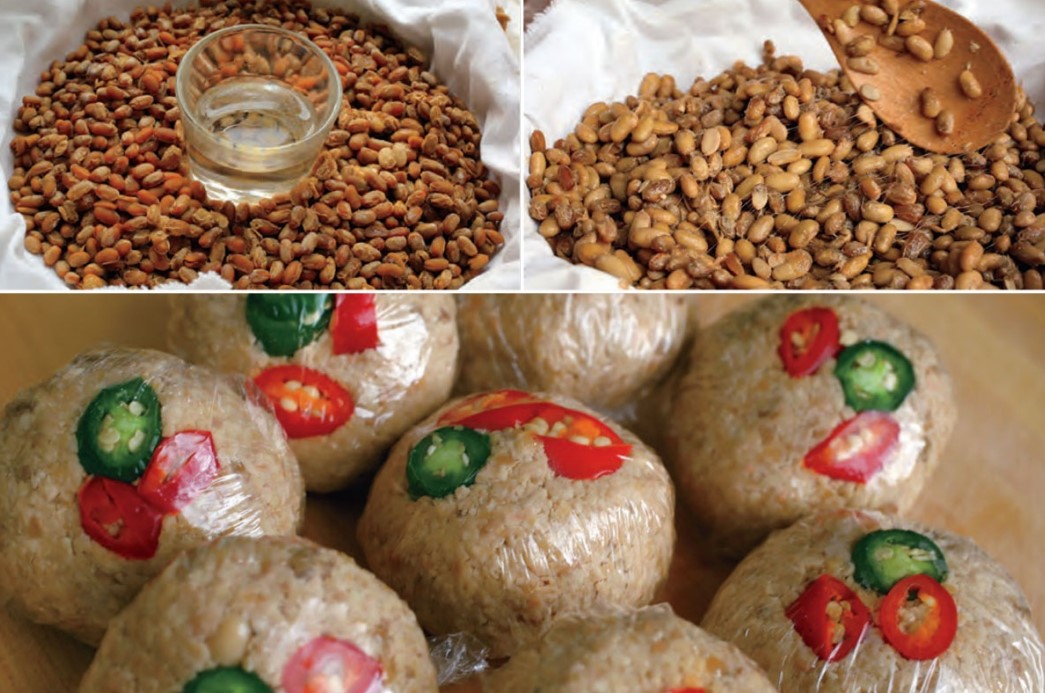
This extra-strong soybean paste is made by fermenting boiled soybeans with the healthy bacteria that float around in the air. It has a much stronger flavor than Fermented Soybean Paste). almost like aged cheese, but it takes a lot less time to make: 2 to 3 days instead of almost a year. Pungent and earthy, cheonggukjang has a slippery texture; it is also much less salty than doenjang. Koreans make a stew with it (see Extra-Strong Fermented Soybean Paste Stew). Koreans have long believed that cheonggukjang is good for your stomach and recent science suggests that Bacillus subtilis, the bacteria
proliferating in the mixture, has probiotic properties that can contribute to digestive health. Researchers are also exploring its possible role in lowering the risk of stroke or staving off dementia (as well as giving a smooth complexion). But there’s no getting around the fact that when the soybeans ferment, they have a very strong smell. I love it, but others call it stinky. I hope you will grow to love it the way we Koreans do, associating the aroma with the soulful fermented soybean paste stew so integral to our cuisine. In the meantime, know that once you place your cheonggukjang in the freezer for later use, its smell will be muted.
Make 6 cups
INGREDIENTS:
- 1 pound dried yellow soybeans (meju-kong), picked over, rinsed, and soaked in cold water for 24 hours
- 1 cup water
- Sliced green and red Korean chili pepper (cheong-gochu or honggochu)
INSTRUCTIONS:
- Drain the beans and rinse a couple of times in fresh water in a large bowl; remove the floating skins and any brownish beans. Drain and transfer to a large heavy pot. Cover the beans with 10 cups water. Bring to a boil over low heat, covered, and cook over low until the beans are soft, about 4 hours.
- Line a large shallow bamboo basket with cotton cloth or cheesecloth. Drain the beans and put them in the basket. Set a small cup filled with 1 cup water in the center of the beans to maintain humidity during
fermentation. Cover the basket with moistened paper towels or a few layers of cheesecloth. - Wrap the whole basket in an electric blanket. Set the temperature to low and let the beans ferment for 48 hours at a temperature between 110° and 130°F—don’t let them get warmer than 140°F. Use an instantread thermometer to check them during fermentation, adjusting the temperature as necessary. Check the temperature with a thermometer often; if it’s more than 130°F, unplug the blanket to lower the heat.
- After 48 hours, uncover the beans. (If they ferment longer, they will smell too strong and may turn sour.) Remove the cup of water and stir the beans well with a wooden spoon. You should see thin, translucent threads when you stir the beans. If you don’t see these, continue to ferment, checking every few hours, until you do.
- Working in batches, pound the beans using a mortar and pestle or process in a food processor until the mixture is partially smooth with a few chunky beans. Divide the paste into 8 portions (about ¾ cup each). Place some chili peppers on each of the balls. Wrap each portion in plastic wrap and roll into a ball. Put the balls in a zipper-lock bag. Use immediately, or freeze for up to 3 months. Defrost overnight in the refrigerator before using.
